
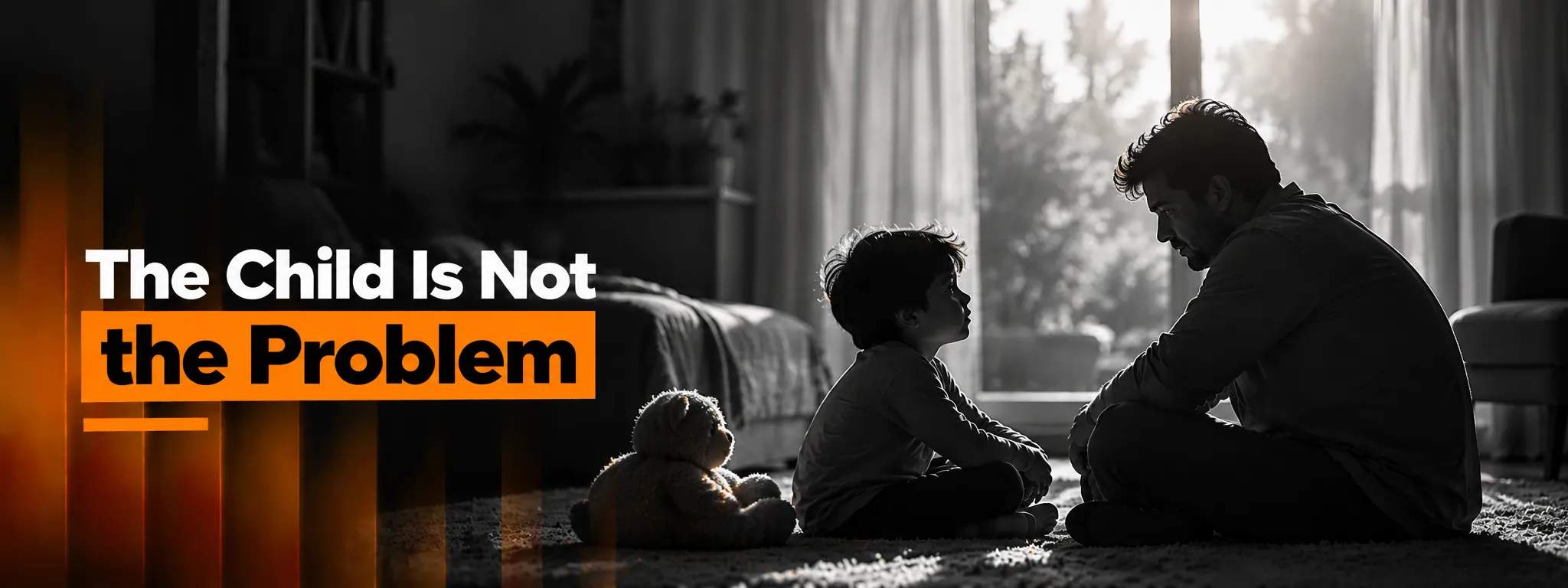
Before we ask what is wrong with our child, perhaps we should ask what our child is learning from us.
The Same Mistake, Two Different Lessons
Consider a simple situation.
A child breaks something at home.
One parent immediately says, “You are so careless. You never listen.”
Another parent may say, “It is alright. But you need to be more careful next time. Come, let us clean it together.”
The mistake is the same, but the experience is different.
One child may slowly begin to associate mistakes with shame and fear. The other may learn that mistakes have consequences, but they can also be corrected.
This does not mean that parents should ignore mistakes or allow children to behave irresponsibly. Children need boundaries. They need to understand consequences. But there is a difference between correcting a child and making the child feel that there is something wrong with them.
That difference can stay with a child for a very long time.
When Anger Meets Anger
Now consider a child who comes home angry.
Perhaps something happened at school. Perhaps a friend said something hurtful. Perhaps the child is frustrated about something they cannot yet explain.
The child responds with anger, and we respond with anger.
“If you speak to me like that, I will show you what anger really is.”
But what are we teaching the child?
That anger should be answered with anger?
That whoever shouts louder wins?
Perhaps the better response is to first understand what happened and then teach the child that being angry is natural, but hurting others because of that anger is not acceptable.
The boundary remains.
But anger does not have to become the language of the home.
A child needs to learn that emotions are not wrong. What matters is how we handle them.
When We Turn Failure Into Comparison
There is another situation many parents will recognise.
A child receives poor marks, and our immediate response is to compare.
“Look at your cousin.”
“Your brother is doing so much better.”
“You are not serious about your studies.”
We may believe that comparison will motivate the child.
But what if the child is learning something completely different?
That their worth depends on their performance.
That someone else will always be better.
That failure means they have disappointed their parents.
Over time, such messages can affect much more than academic performance. They can influence how a child sees himself, how he responds to failure, and whether he feels safe coming to his parents when something goes wrong.
Perhaps instead of asking, “Why did you get such poor marks?” we can sometimes ask, “Where did you find it difficult, and how can we help you improve?”
The expectation remains.
But the relationship remains safe too.
Tarbiyat Is More Than Correction
This is why I believe Tarbiyat is much more than teaching a child what is right and wrong.
It is the environment we create.
It is the values we demonstrate.
It is the words we repeatedly use.
And it is the way we respond when our children are afraid, angry, disappointed, confused, or wrong.
A child is not growing only through the instructions we give them. They are also growing through the experiences we create for them every day.
This is one of the reasons I have written about parenting and Tarbiyat. My book, Tarbiyat-e-Aulad Ka Nizaam, explores these ideas and encourages parents to look beyond simply correcting behaviour and develop a deeper understanding of their role in a child’s upbringing.
Before You Change Your Child, Look at Your Response
Parenting is not about getting the perfect response every time. None of us can achieve that. We are parents, but we are also human beings, and we are learning as we go.
What matters is becoming conscious of the responses we repeat.
Because children don’t only learn from what we tell them.
They learn from how we treat them when they are afraid, angry, disappointed, or wrong.
So the next time you find yourself thinking, “My child needs to change,” pause for a moment and ask yourself:
“Is there something in my parenting that also needs to change?”
This is not about blaming parents.
Parenting is difficult. Every child is different. Every family has its own circumstances, and no parent will respond perfectly in every situation.
It is simply about becoming more aware of the small things we do every day, because those small things gradually become part of a child’s understanding of himself, his relationships, and the world around him.
Sometimes, when we change the way we respond to a child, we begin to see a change in the child as well.
A Better Relationship Begins With Awareness
Perhaps the goal of parenting should not simply be to raise obedient children.
Perhaps it should be to raise children who understand responsibility, know how to manage their emotions, can learn from their mistakes, and feel secure enough to come to their parents when life becomes difficult.
That requires more than rules.
It requires awareness.
And sometimes, the first step is not changing the child at all.
It is looking at ourselves.
If you feel you need more guidance in understanding your child, managing your own responses, and building a healthier relationship at home, I have also developed a structured Effective Parenting Course that explores these areas in greater depth.
Want to Become the Parent Your Child Needs?
Understanding your child’s behaviour is important. But learning how to respond with patience, communicate effectively, and set healthy boundaries is what makes a real difference.
The Effective Parenting Course by Prof. Dr. Javed Iqbal provides practical guidance to help you understand your child better, manage challenging behaviour, and build a relationship based on trust, respect, and emotional understanding.